
Drama 221a – Visual Narrative In Performance
Winter 2026 – Tue/Thu 1.30-3.20p
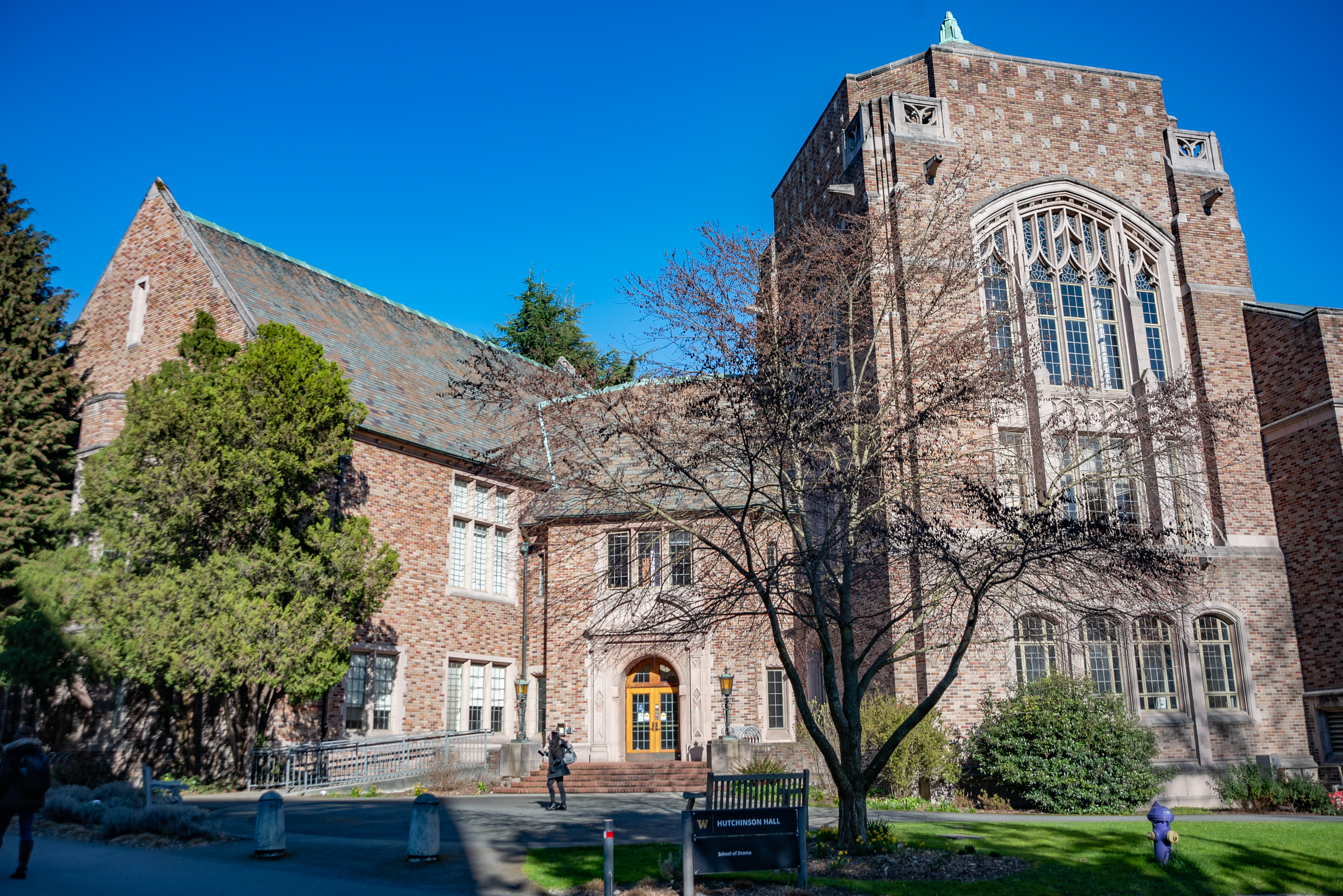
Location: Hutchinson Hall (HUT) 130
Instructor: Sara C. Walsh swalsh1@uw.edu
Office: HUT 170
Office hours: Thurs 12p-1:30p
or e-mail to schedule an appointment
TA: Alex B Taylor abtaylor@uw.edu
This syllabus, like life, is subject to change.
You can download a pdf of this syllabus here.
Course description
“Story” – or narrative – structures most forms of crafted performance events. Theatre, dance, live music, fashion runway or halftime shows, all have narrative arcs: a deliberate sequence of changes over time. Designers concerned with shaping these experiences are fundamentally concerned with narrative structure, and with how their design choices can support, enhance, complicate, or undermine the trajectories of these “stories.” While this introductory course will examine the standard design disciplines of scenery, costumes, lighting and sound through the lens of narrative, its primary focus is on the raw materials of experience itself: image and sound, space, time, and above all, change. Through a range of analytic exercises, creative assignments, and collective devising, students will work towards individual design projects developed for a selection of short plays or developed expansions of previous work.
All art is experienced in time, although the duration of that experience is variable – set and predetermined (movies), left up to us (paintings in a gallery), or something in between. It is only the performing arts – live music, dance, theater, etc. – in which the passage of the event is generally experienced by the performers and their audiences simultaneously. It happens in real time, and that shared experience is in fact its most salient feature; we “go through it” together. In a very real sense, that time spent together is the story.
Designers for such events are concerned not only with shaping how the story is told, but, more crucially, how it is perceived. While in some cases, as in costumes or sets, their designs may be discrete, a series of unchanging conditions (at least for the duration of a scene); in others, in lighting or sound design for example, the design is precisely one of flux, shifting as need be over time. But in all cases the designers must address in their plans the larger narrative structure, the arc of the story as a whole: the necessary scene-to-scene changes of clothing, for example, or the transformation of a set from one location to another. Or not: each project requires its own approach.
This class is an introductory design class in a school of theatre, but it’s really more about perception – about paying attention to our own experiences of the real world circumstances, conditions and events that will eventually give substance and interest to our designs: our experience of space, for example, and the other people in it, through a passage of time; the information we derive from light and the way that sound can affect mood almost undetected; the dance between the ordinary and the extravagant, in clothing & setting; and the tension between the real and the imaginary, and the artifice that goes into tapping them simultaneously to dramatic purpose. Our definition of narrative performance is broad enough to encompass both Olympic opening ceremonial spectacles and routine campus tours – anything that has been shaped and sequenced for cumulative aesthetic experience for a participating audience. We will work out from where we are already, from what we have and what we know, to try and coax magic from our grounded lives, to find something richer within them.
The class is organized around a collection of topics that are focused on different aspects of design for storytelling, with in-class exercises and homework assignments to activate your exploration of each of them. Many assignments include an opportunity for self-assessment, as well as a means to respond to classmates' work. Some of these assignments build on each other in sequence; others are stand-alone. At least one will be a group project. Some may be used as foundations for your final projects. In general I'm not looking for skill or polish, but for engagement, focus and growth.
Learning goals:
- Students will learn to identify, analyze, and devise the structures of a performance event (play, dance, campus tour, etc.), and to develop design concepts that address the changes over time these structures may require.
- They will develop the muscle of analyzing and critiquing the story that design tells us in live performance.
- They will refine their practice of looking, including periods of immersive attention.
- They will acquire language and tools to talk about, explore, and create holistic worlds for live performance including space, clothing, sound, light, video, experience and other modalities.
- Individually and in groups, they will devise and present short performances in found spaces, utilizing concepts and tools mentioned above.
- They will cultivate practices of observation and discernment of the impact of design on human experience, in both audiences and in themselves.
By focusing on the questions of change, duration and sequence common to all performative events, this course prepares students to think of performance holistically: each part as mutable components of a larger expressive project through time, as opposed to discrete finished areas (set, costume, acting, directing etc). Further, by proposing a more capacious definition of the narrative event, the class invites students to draw ideas and inspiration more liberally from their own experiences of the world.
Grading
Grades will be based upon understanding of the subject matter, effort, achievement in the assignments, specificity in following the stated directions, and constructive class participation. Proper writing skills are not important, as long as you can clearly express yourself. It is more important to give careful consideration to the specifics of the assignment and turn it in on time than to demonstrate mastery of English language skills. All work is due on the day and time it is listed in Canvas even if you are not in class that day. All late work will be docked 2 points if it is not turned in by the stated time. If an assignment is not turned in within two weeks of its due date then you will receive zero points for it. Near the end of the quarter this two week allowance will shrink, and no outstanding assignments will be accepted after 11.59p of Saturday 14 March. If you are not able to turn in an assignment on time, e-mail me by 8p the evening before it is due with a proposed extended due date. With the exception of the Production critique and the Final project, all extensions will be considered if submitted on time. If you do not complete an assignment, you will receive zero points for it. Unless you reach out to me to get an approved absence you are expected to attend all class sessions and to be on time. If you miss a class without previously reaching out to me or you do not have extenuating circumstances (e.g. you are in the hospital), then you will receive zero participation points for that class.
Class participation 100 points
Homework assignments 400 points
Peer reviews of specified assignments 40 points
Production critique 40 points
Ninety Minutes 40 points
Final project 80 points
Total 700 points
4.0 = 700 points = 100%
3.5 = 630 points = 90%
3.0 = 560 points = 80%
2.5 = 490 points = 70%
2.0 = 420 points = 60%
Class participation
This class will include presentations and discussions of your work. You can only participate in class discussions if you are present and have done the assigned homework. Everyone will be expected to participate in class discussions and exercises, and to provide constructive feedback on each other’s work. While there may be reasons for you to miss a class that are beyond your control (e.g. you are in the hospital), whether or not you attend class is a choice, and choosing to miss class may result in zero class participation points for that day. Participation points are given for being on time to class, having read through and completed assigned homework, and for active engagement in class discussions and exercises. Post-class reflections and questions can also be contributed through Canvas discussion postings. If you know you will need to miss a class, you must e-mail me in advance so we can make arrangements. Unless there is a reason that is beyond your control, I will not retroactively approve an absence. If you need to miss further classes for the original reason you must reach out for each class session individually. At the end of the quarter this will be worth 14% of your final grade.
Class discussions will include your classmates’ opinions, and everyone’s opinions are valid, even when they’re different from your own. It is important to listen to each other and have civil and respectful discourse. Art, which theatre and design are, is subjective rather than objective. Each and every person will have a different response to art, which is why it is so exciting to investigate. Listening and trying to understand how someone else responds to something can open up your own perceptions and help bring new insights. This class (including the classroom and all related online forums) is a safe, supportive place where everyone will be heard with empathy and kindness. Personal attacks, racism, sexism, and micro-aggressions will not be tolerated.
Homework assignments
Most class periods there will be assignments due at or before the class starts. They will be listed in Canvas, and may be mentioned before or discussed when assigned. Make sure you read through the assignments thoroughly to be sure that you understand specifically and accurately what is expected from you. The assignments will be geared towards realizing the learning goals of the class, and may include reading texts or other source materials, watching videos, walking around campus, or reflecting on your own responses and experiences. Some will be creative, others will be analytical. Often these assignments will become the backbone of class discussion, where submissions may be read out loud or displayed to the rest of the class. In general they will be posted in Canvas one week before they’re due. Usually assignments will be due ahead of the specified class session so I can collect and prepare them for class discussion, while sometimes you will bring them to class finished. Always check Canvas to be sure when things are due, and reach out to me if you have any questions. At the end of the quarter your cumulative assignment scores will be worth 57% of your final grade.
Peer reviews
Many of the assignments will include a Peer review component. After the assignments are due, you will be assigned to look at two or three fellow classmates’ work and thoughtfully critique it. You want to give your classmates constructive responses, observations and ideas that they can use to make their work better. “I really liked it” might be gratifying to hear, but it’s also way too easy and it’s not useful. It doesn’t tell them what about their work was successful for you, what moved you in a positive way. Instead, be specific, tell them what you think worked well and why. Tell them what you didn’t understand or felt was incomplete, underdeveloped or unnecessary. But don’t tell them how to make it better; that’s for them to decide. The point of this is to develop your own critical eye (or ear), and to learn how your work is being received from different perspectives. Only through exercising your critical muscles can you develop your own sense of taste. Always keep in mind when writing your Peer reviews that this class is a safe space where opinions are valued, and civil and respectful discourse is of utmost priority. At the end of the quarter your cumulative Peer reviews will be worth 6% of your final grade.
Ninety Minutes
Early in the quarter you will be given an assignment to spend ninety minutes with one piece of art. You can have no devices out ( other than to take a photo of the art before and after the 90 minutes), take no notes, make no sketches. Just you and the art. Afterward, you should write a one page first person accounting of your experience. It will be most effective to write the account as soon as possible after having the experience. This assignment is worth 6% of your final grade.
Production critique
There is a lot of live performance on campus and in greater Seattle, and theatre makers of all kinds are often inspired by other shows that they attend. This quarter the School of Drama is producing Seagull by Anton Chekov (opening night January 29) and Bunny by Hannah Moscovitch (opening night March 12) both at the Floyd and Delores Jones Playhouse (student tickets $10, Drama Majors get comps, see UW DRAMA TICKET POLICY ). There are shows happening at the Meany Center. In greater Seattle you can also see live performance at many venues including Seattle Rep, Union Arts, Intiman, Pacific Northwest Ballet, Seattle Opera, On the Boards and the Fifth Avenue. You will be expected to attend one live performance this quarter and write a critique of the whole experience, paying special attention to its designs.
You can choose any show you want as long as you are not involved in the production and there is a credited design team. As you watch it, pay attention to all of the different design disciplines in the show (scenic, costumes, lighting, sound, video/projections), how they’re used, what their relationships are, how they help tell the story, how cohesive and connected they are to each other, what you think they were trying to achieve in their choices, and whether or not you think they work for the production. Write a minimum of one page critiquing the designs in the show. Unless you specifically give permission, this assignment will not be shared with the rest of the class or anyone else, so feel free to be honest without worrying about hurting anyone’s feelings. Your critique will be graded on the detail of your observation, your analysis of the designs and how they fit in the production, and how clearly you express your feelings. It is due anytime before Saturday March 14 with no possible extension, but I recommend writing it shortly after you attend the show so your thoughts are fresh. At the end of the quarter your critique will be worth 6% of your final grade.
Final project
The final project will be a narrative performance piece that you will create and design and the rest of the class will experience. There will be class time devoted to it, and further details will be presented later in the quarter. Your Final project will be worth 12% of your final grade.
Extra Credit
There may be opportunities to complete non-required exercises over the course of the quarter for extra credit. One such exercise is “Preshow Music”:
Before each class session begins I will be playing “preshow” music in the classroom to help welcome you into the space. This is your chance to earn extra credit. Before noon of each class period one person can provide a Spotify playlist to me that we will listen to as “preshow”. These playlists should last 15-30 minutes and should have some sort of theme. Themes can be as simple as “songs that start with the letter A” or as complex as you want them to be. These playlists are not meant to be mixed DJ sessions or anything complex, just a fun sharing of what you’re enjoying at the moment, or an insight into your musical inspirations. We will start each class with a brief explanation of what your theme is and why you chose the music that you did. Participation can earn you 20 extra credit points. No one is required to do this, it is purely voluntary, but you must sign up in advance, and you can only sign up for one slot. If you sign up for a slot but then don’t submit your playlist by noon of your day then you will not receive any extra credit, and we will have no “preshow” music to listen to that day. All of these playlists will be shared with the other students.
Texts and materials
There are no books to buy. All assigned readings and other materials will be available in Canvas.
Technology: While I will be delighted if you want to submit hand drawn work, you may generally prefer to create them in various design apps like Photoshop or Illustrator, then upload the finished work to Canvas. A couple of the assignments will be “mood boards” or similar, essentially collages of images you’ve selected. There are free collage apps online. I have no preference what apps you use, as long as I am able to open and access your work.
The Adobe Creative Cloud package (Photoshop, Illustrator, Lightroom, Premiere, After Effects) can be subscribed at the educational rate of about $20 a month with a one year contract, or about $35 a month with no contract. There is also the free online photo editor Photopea, which I have heard good things about. The School of Drama has some computers with design apps on them in rooms that you can access during “daytime hours”. You can also find the apps on computers in the Odegaard Learning Commons. Unfortunately, Odegaard is only open 9a-5p. If these hours do not work for you, let me know and we’ll see what we can do to accommodate you in Hutchinson Hall. You may also get a laptop loan for the term from the Student Technology Loan Program. Visit https://stlp.uw.edu/ to learn more about that program.
If you are working on university computers you must have a separate file storage device of your own or access to online storage. If you save your work on the computer, it will be deleted at the end of the day. I would recommend a device of no less than 64GB.
Academic misconduct
Most of the assignments in this class are based around your own creative work and reflections. You will be expected to follow the University of Washington’s policies around academic honesty and integrity. They can be found here:
https://www.washington.edu/admin/rules/policies/SGP/SPCH209.html#7
Anyone who violates these policies either in or outside of the classroom will be reported.
COVID & Masking Policy
UW no longer requires use of masks in our buildings or for our classes. Mask wearing is optional for all students, faculty, and staff. You may decide individually if you will be wearing a mask during class. The option for individuals to remain masked will be respected during all classes and projects. If the UW covid policy changes then this class will also adopt this change.
If you are COVID-positive, you should not attend class. Please contact me to let me know you will be missing class that day.
Accommodations (DRS)
If you have already established accommodations with Disability Resources for Students (DRS), please communicate your approved accommodations to me at your earliest convenience so we can discuss your needs in this course.
If you have not yet established services through DRS, but have a temporary health condition or permanent disability that requires accommodations (conditions include but not limited to: mental health, attention-related, learning, vision, hearing, physical or health impacts), you are welcome to contact DRS at 206-543-8924 or uwdrs@uw.edu or disability.uw.edu. DRS offers resources and coordinates reasonable accommodations for students with disabilities and/or temporary health conditions. Reasonable accommodations are established through an interactive process between you, your instructor(s) and DRS. It is the policy and practice of the University of Washington to create inclusive and accessible learning environments consistent with federal and state law.
Accommodations (Religious)
Washington state law requires that UW develop a policy for accommodation of student absences or significant hardship due to reasons of faith or conscience, or for organized religious activities. The UW’s policy, including more information about how to request an accommodation, is available at the Religious Accommodations Policy. Accommodations must be requested within the first two weeks of this course using the Religious Accommodations Request Form.
Civility, Inclusion, Diversity
Among the core values of the university are inclusivity and diversity, regardless of race, gender, income, ability, beliefs, and other ways that people distinguish themselves and others.
The experience of every student in this class is important to us and to the success of the class as a whole. We believe that collaboration (and all decision-making) is more thorough and more effective when it is done with a collection of diverse individuals. We believe that diversity is integral to excellence. For collaborative processes to work, it is critical to create a space where collaborators can speak openly and encourage each other to take risks. Such a space needs to be respectful, safe and inclusive. While we will collectively create a set of agreed-upon norms for our classroom, the success of this class will depend on each person’s willingness to agree to some common aspects of civility. Each person is expected to maintain the highest respect and standards of courtesy to each other. We ask that you respect the legitimacy of your peers’ lived experiences and that you participate in this class with that in mind. Disagreements can occur (and will), but they must always co-exist with respect. This will mean recognizing that the impact of your words or actions may have unintended impact on others in the class, and if so, acknowledging that impact (regardless of intention) would be an important component of that respect. This course is designed to engage students across a number of dimensions including race, ethnicity, gender, sexuality, class, age, religion, and disability.
The UW Food Pantry
A student should never have to make the choice between buying food or textbooks. The UW Food Pantry helps mitigate the social and academic effects of campus food insecurity. We aim to lessen the financial burden of purchasing food by providing students with access to food and hygiene products at no cost. Students can expect to receive 4 to 5 days’ worth of supplemental food support when they visit the Pantry. For information including operating hours, location, and additional food support resources visit https://www.washington.edu/anyhungryhusky/the-uw-food-pantry/.
School of Drama Consent Policies
- Consent: Consent is mutual communication and respect for each other’s physical boundaries. It is Considered, Reversible, Informed, Specific, Participatory.
- The School of Drama cares about creating learning and training environments that equitably support students across all identities with strong consent policies.
- Strong consent policies enhance student learning.
- Brave space learning environments allow us to explore theories and practices of theater in ways that do not violate or sexualize others, especially students.
- Every student who moves through this program will be honored in the work of theater.
- Through a shared understanding of consent, students – undergraduates and graduate students - can stretch, grow, and make big choices as artists.
- For additional resources see the FRIES + CRISP tools of consent
- Our Cultural Values
Accountability:
- We will name harm and seek repair when harm happens.
- We have made an accountability and action plan for faculty, staff, and students. Link here. All students are responsible to the UW’s Student Code of Conduct,
Personal Relationships:
- Romantic and/or sexual relationships between graduate students and undergraduate students are discouraged
- This applies to students and faculty/staff as well.
- If you are feeling harassed or violated, that is not okay. We want to hear about it and we can help.
Class Content and Student Conduct:
- The School of Drama believes the formal classroom environment and related academic activities, including productions, lectures, and other events, should be respectful spaces where sensitivity to personal backgrounds, experiences, and beliefs can be balanced with rigorous and thoughtful discourse.
- If you believe material and/or experiences in the course will compromise the success of your learning, please consider one or more of the following options: 1) approach your instructor and share your concern: you may be able to find a suitable alternative arrangement or assignment; 2) Speak with the program area head or Executive Director about your concern
- Voicing A Concern: All students have a right to engage and work in the School of Drama without being sexualized or harassed. If you are in a class, and you feel like you are being sexualized or harassed in any way, you can get help through the resources linked below.
- School of Drama voicing a concern policy [link]
- Safe Campus [link]
- Counseling Center [link]
- Title IX [link]
IMPORTANT UPDATE from Executive Order #81:
If the complaint or concern involves discrimination, harassment, misconduct or retaliation based on a protected characteristic of race, color, creed, religion, national origin, citizenship, sex, pregnancy, age, marital status, sexual orientation, gender identity or expression, genetic information, disability, or veteran status, the faculty or staff member (or any UW employee) will be required to make a report to the University Civil Rights Compliance Office (CRC).
- If you are a UW student employee reporting to one of your supervisors a concern that involves one of the protected characteristics, the supervisor will be required to include your name in the report.
- If you are a student, but NOT a UW student employee (or if you are a student employee NOT reporting to your supervisor), your name will not be required to be included in the report and you can remain anonymous if you wish.