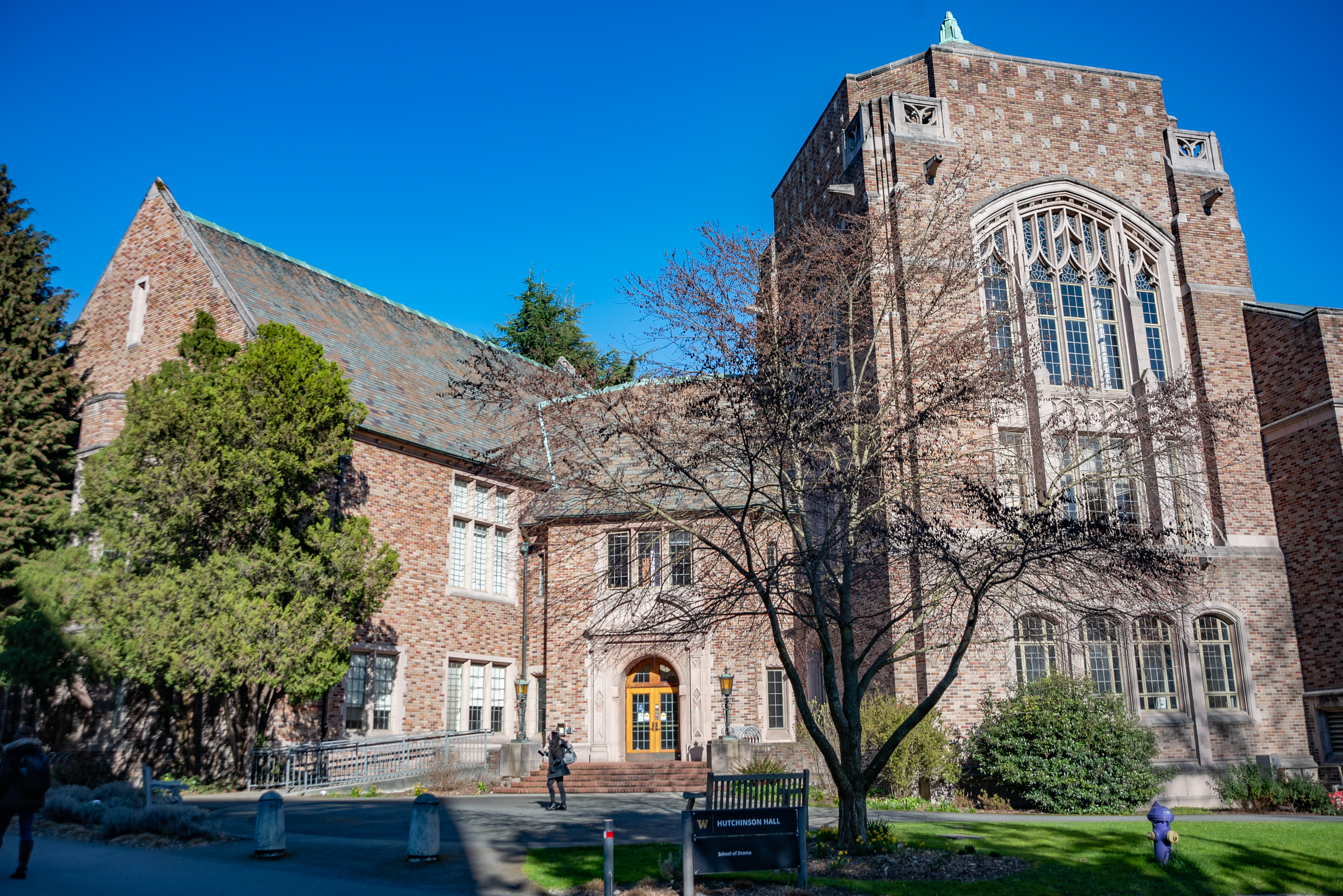

University of Washington School of Drama. Spring 2026 Drama 352 Verse Syllabus
Instructor: Associate Teaching Professor Bridget Connors, Designated Linklater Voice Email: connorsb@uw.edu
Class meets: Monday/Wednesday 9:30-11:20 am Hutchinson 202
Office hours: 215 Hutchinson by appointment.
Course description: Exploration of Shakespeare’s verse through vocal, physical, text analysis and acting exercises. By studying the demands of verse in an experiential way, the language can begin to live through you, enhancing your own connection to heightened text, character, and the world of the play. Students will work on monologues, scenes, and sonnets.
Course Materials:
- Textbook: A Complete Works of Shakespeare. Recommended: The Riverside Shakespeare
- Notebook: Every class: bring a notebook to record notes and assignments; pencil, eraser, pen.
- Resources: Various handouts/audio/visual materials will be given out during the quarter.
Recommended Texts: Numerous sources will be discussed during the quarter as recommended text
Learning outcomes/ course objectives
- Speak from the full body connecting breath and vibration with ease, clarity, imagery and emotional impulse. Increase vocal range, texture and musicality of language.
- Recognize and embody imaginative and creative discoveries.
- Ability to speak verse embodying the structure of language (operative words, figures of speech, specificity of thought, architecture, rhythm) through verse/text analysis.
- Understand the text to illuminate the story.
- Highlight your unique individual voice in Shakespeare’s world and make it your own.
- Performance of sonnet, monologue, scene, and final project.
Evaluation: (Grading is based on a 1000 point scale/see Grading scale, attached):
Participation: 400 total points
Daily class exercises, adhere to class expectations, active and willing participation
Assignments: Specific assignment details to be discussed in class
Written work
Monologue text analysis 100 points ( 10 at 10 points each)
Scene text analysis 100 points
Journal assignments 100 points ( 10 at 10 points each)
Performance work:
Monologue 100 points
Scene 100 points
Final project 100 points
Total Points : 1000 points
Class expectations: Your work in class, completion of assignments, participation within the ensemble and commitment to class expectations will factor into your final grade.
Participation: Students are expected to be in class, on time, and prepared to work. As the learning happens experientially in class, you must be present for the learning to happen. As such, absences and late arrivals will adversely affect your grade. If you are unable to be in class in due to extenuating circumstances, please notify me via email prior to class. If you miss the work in class, it is your responsibility to complete missed assignments, obtain classroom materials, notes and instructions , and schedule to make up work.
Come prepared. Come prepared; completion of assigned readings, memorization and outside rehearsal of assigned text, and entries in weekly voice journal. Review class exercises outside of class as each class will build upon the last.
Stay engaged. Stay engaged in class as an actor and audience member as it directly influences the work of everyone in the class and will directly influence your participation points. In class, it is expected that you maintain a professional demeanor and give respectful attention to others in class and the instructor. This includes being focused, present and engaged; receptive to direction and feedback; prepared, diligent in study, and rigorous in care of class policies and ensemble boundaries; and committed to a positive approach and a spirit of willingness.
Sleeping, devise usage, or classwork from other courses is not permitted. Unless you have a written permission from Disability Services, all electronics must be silent and put away during class. Bring paper and pen with you to every class. Please refrain from chewing gum or eating food during class, unless on a break.
Attire/phones: wear loose clothing to move freely, no hats, jewelry, per above, cell phones off in class.
Cause for concern:
Lack of commitment and/or preparation, nonfulfillment of an assigned task, not experimenting or participating fully in class work. Disrespect of anyone in the classroom, including talking while others are working; inappropriate, unprofessional, or disruptive behavior, not establishing and promoting and ensemble/collegial atmosphere. Late assignments or failure to memorize a text as assigned.
Assignment details: Late assignments will not be accepted unless a prior arrangement has been made with me. Specific assignment details to be discussed in class. Subject to change.
Written work:
Text analysis assignments will be posted in Canvas and due as assigned.
Weekly journal assignments will be posted in Canvas and due assigned.
Performance work: We will apply what we are learning about the language to several different texts throughout the semester. Students are responsible for memorizing these texts by the agreed upon deadline. Students responsible for rehearsing outside of class on the material and with scene partners. Texts will be shared in performance during class time.
Final Project: Students will work to develop and share a performance piece on exam day.
Class Schedule: The following is a guideline; subject to change
Week One: March 30-April 1 Sonnets
Mon March 30 Introductions. Review syllabi. Exercise: The experience of speaking.
Wed April 1 Discussion: The paradox of Shakespeare. Sonnet exercise. Journal # 1.
Week Two: April 6-10 Monologues
Mon April 6 monologues selected. Group warmup/text.
Wed April 8 Breath. Imagery. The creation of thought. Journal # 2. Text analysis 1,2.
Week Three: April 13-17 Monologues
Mon April 13 The heartbeat: Scansion. Line endings
Wed April 15 The sound of language: Figures of speech, word content. Journal # 3. TA 3,4,5
Week Four: April 20-24 Monologues
Mon April 20 Architecture: climb the ladder, antithesis, argument. Monologue coaching in class
Wed April 22 Monologue coaching in class. Journal # 4. TA 6,7,8
Week Five April 27-May 1 The Prologue
Mon April 27 Performance of monologues- memorized. TA 9.10
Wed April 29 The prologue. Scene selections. Journal # 5. Complete Monologue text analysis due.
Week Six: May 4-May 8 Scenes
Mon May 4 Begin scenes -first rehearsal
Wed May 6 Scene work -second rehearsal. Journal # 6
Week Seven: May 11-15 Scenes
Mon May 11 Scene work- third rehearsal
Wed May 13 Scene work- fourth rehearsal. Journal # 7
Week Eight: May 18-24 Scenes
Mon May 18 Performance of scenes-memorized
Wed May 20 Performance of scenes- memorized. Journal # 8
Week Nine: May 25-29 Tutorials
Mon May 25 Memorial Day School closed.
Wed May 27 Tutorials. Scene Rehearsal time. Journal # 9
Week Ten: June 1-3.
Mon June 1 Rehearse final project.
Wed June 3 Last class, rehearse final project. Journal # 10.
Wed June 10 8:30-10:30 am (alternate time available?) Final Performance project
Grading Scale
The grading scale for this class is based on a 1000-point system. The 1000-point system is then converted into the University’s grade-point system as outlined below:
A 4 950-1000 points C+ 2.2 720-729.9
A 3.9 940-949.9 C 2.1 710-719.9
A- 3.8 930-939.9 C 2 700-709.9
A- 3.7 920-929.9 C 1.9 690-699.9
A- 3.6 910-919.9 C- 1.8 680-689.9
A- 3.5 900-909.9 C- 1.7 670-679.9
B+ 3.4 880-899.9 C- 1.6 660-669.9
B+ 3.3 860-879.9 C- 1.5 650-659.9
B+ 3.2 840-859.9 D+ 1.4 640-649.9
B 3.1 820-839.9 D+ 1.3 630-639.9
B 3 800-819.9 D+ 1.2 620-629.9
B 2.9 790-799.9 D 1.1 610-619.9
B- 2.8 780-789.9 D 1 600-609.9
B- 2.6 760-769.9 D- 0.8 580-589.9
B- 2.5 750-759.9 D- 0.7 570-579.9; Lowest passing grade.
C+ 2.4 740-749.9 F 0 0-569.9; Failure or Unofficial
C+ 2.3 730-739.9 Withdrawal; no credit earned.
Inspirations:
Some thoughts on words and language from the Uruguayan writer Eduardo Galeano:
“ I was looking for a language who could integrate everything that has been culturally divorced from, for instance, heart and mind. I was looking for a feel-thinking language, sentipensante, it’s a word. I think that when the world, perhaps one day the world, our world, won’t be upside down, and then any newborn human being will be welcome. Saying, “Welcome. Come. Come in. Enter. The entire earth will be your kingdom. Your legs will be your passport, valid forever. And for me, this is true also for words”.
“Words mean more than what is set down on paper. It takes the human voice to infuse them with deeper meaning”. Maya Angelou
“Ay, is it not a language I speak?” William Shakespeare
Communication: Please let me know how I can support you in your journey in class and in the program. If you are unclear about any assignments or the work we are doing, please let me know. If my words or actions are disruptive, are not conducive to your learning, or cause you distress or harm in any way, please let me know. I am here to serve you and your artistic goals, dreams and desires. I am honored to go on the journey with you individually and with our collective ensemble, as we celebrate our diversity, our perspectives, our intuition, our wise actor bodies, our voices, and our stories. Thank you. Bridget
Policies, guidelines, resources:
“ The University of Washington acknowledges the Coast Salish people of this land, the land which touches the shared waters of all tribes and bands within the Duwamish, Suquamish, Tulalip and Muckleshoot nations."
School of Drama Consent Policies – Syllabus Language
- Consent: Consent is mutual communication and respect for each other’s physical boundaries. It is Considered, Reversible, Informed, Specific, Participatory.
- The School of Drama cares about creating learning and training environments that equitably support students across all identities with strong consent policies.
- Strong consent policies enhance student learning.
- Brave space learning environments allow us to explore theories and practices of theater in ways that do not violate or sexualize others, especially students.
- Every student who moves through this program will be honored in the work of theater.
- Through a shared understanding of consent, students – undergraduates and graduate students - can stretch, grow, and make big choices as artists.
- For additional resources see the FRIES + CRISP tools of consent
- Our Cultural Values
Accountability:
- We will name harm and seek repair when harm happens.
- We have made an accountability and action plan for faculty, staff, and students. Link here. All students are responsible to the UW’s Student Code of Conduct,
Personal Relationships:
- Romantic and/or sexual relationships between graduate students and undergraduate students are discouraged
- This applies to students and faculty/staff as well.
- If you are feeling harassed or violated, that is not okay. We want to hear about it and we can help.
Class Content and Student Conduct:
- The School of Drama believes the formal classroom environment and related academic activities, including productions, lectures, and other events, should be respectful spaces where sensitivity to personal backgrounds, experiences, and beliefs can be balanced with rigorous and thoughtful discourse.
- If you believe material and/or experiences in the course will compromise the success of your learning, please consider one or more of the following options: 1) approach your instructor and share your concern: you may be able to find a suitable alternative arrangement or assignment; 2) Speak with the program area head or Executive Director about your concern
- Voicing A Concern: All students have a right to engage and work in the School of Drama without being sexualized or harassed. If you are in a class, and you feel like you are being sexualized or harassed in any way, you can get help through the resources linked below.
- School of Drama voicing a concern policy [link]
- Safe Campus [link]
- Counseling Center [link]
- Title IX [link]
IMPORTANT UPDATE from Executive Order #81:
If the complaint or concern involves discrimination, harassment, misconduct or retaliation based on a protected characteristic of race, color, creed, religion, national origin, citizenship, sex, pregnancy, age, marital status, sexual orientation, gender identity or expression, genetic information, disability, or veteran status, the faculty or staff member (or any UW employee) will be required to make a report to the University Civil Rights Compliance Office (CRC).
- If you are a UW student employee reporting to one of your supervisors a concern that involves one of the protected characteristics, the supervisor will be required to include your name in the report.
- If you are a student, but NOT a UW student employee (or if you are a student employee NOT reporting to your supervisor), your name will not be required to be included in the report and you can remain anonymous
Note on Class Content in the School of Drama
Throughout history, theatre and performance have grappled with the world’s most complicated subject matter, including violence, sex, and psychological and emotional conflict. To this end, much of the world’s theatre and performance is “adult-themed” and includes references to or representations of violence, intimate sexual activity, and adult language (including coarse terms, obscenities, and slurs). Performance is a forum in which the world’s conflicts can be contemplated and discussed, and performance can often even be a tool for positive change. As such, the School of Drama believes the formal classroom environment and related academic activities, including productions, lectures, and other events, should be respectful spaces where sensitivity to personal backgrounds, experiences and beliefs can be balanced with rigorous and thoughtful discourse.
If you believe material and/or experiences in the course will compromise the success of your learning, please consider one or more of the following options: 1) approach your instructor and share your concern: you may be able to find a suitable alternative arrangement or assignment; 2) contact a Livewell Student Advocate in Health and Wellness who will help determine how a past incident may be impacting your academic success and will work with your courses and professors: hwadvoc@uw.edu; 3) Contact UW Student Coaching and Care, which has staff trained to help students in distress and in need of multiple levels of support: ajmyhre@uw.edu.
Student Code of Conduct: The University of Washington Student Conduct Code (WAC 478-121) defines prohibited academic and behavioral conduct and describes how the University holds students accountable as they pursue their academic goals. Allegations of misconduct by students may be referred to the appropriate campus office for investigation and resolution. More information can be found online at https://www.washington.edu/studentconduct/
Academic Integrity: Please refer to the Bachelor’s Degree Planbook for the College of Arts and Sciences and the Student Conduct Code to learn what behaviors constitute academic misconduct and applicable penalties (i.e. plagiarism).
Religious Accommodation
“Washington state law requires that UW develop a policy for accommodation of student absences or significant hardship due to reasons of faith or conscience, or for organized religious activities. The UW’s policy, including more information about how to request an accommodation, is available at Religious Accommodations Policy (https://registrar.washington.edu/staffandfaculty/religious-accommodations-policy/.. Accommodations must be requested within the first two weeks of this
” Access and Accommodations:
Your experience in this class is important to me. It is the policy and practice of the University of Washington to create inclusive and accessible learning environments consistent with federal and state law. If you have already established accommodations with Disability Resources for Students (DRS), please activate your accommodations via my DRS so we can discuss how they will be implemented in this course. If you have not yet established services through DRS, but have a temporary health condition or permanent disability that requires accommodations (conditions include but not limited to; mental health, attention-related, learning, vision, hearing, physical or health impacts), contact DRS directly to set up an Access Plan. DRS facilitates the interactive process that establishes reasonable accommodations. Contact DRS at disability.uw.edu ..
Safe Campus . Call Safe Campus at 206-685-7233 anytime – no matter where you work or study – to anonymously discuss safety and well-being concerns for yourself or others. Safe Campus’s team of caring professionals will provide individualized support, while discussing short- and long-term solutions and connecting you with additional resources when requested.
Covid Acknowledgment :“These are difficult times, and we want to accommodate students as best we can. The university has resources for health and wellness and are available if you feel the needhttps://wellbeing.uw.edu/topic/mental-health/. COVID-19 Facts and Resources: The School of Drama is working every day to ensure the continued safety of our students in the face of the COVID-19 pandemic. Please refer to the University of Washington Coronavirus website for current Covid protocols and guidance, www.washington.edu/oronovarius/. Any recommendations or changes regarding masking during class will be based on current University policy. You are welcome to wear as mask at any time.