Revised April, 2026
Production Support Framework
INTRODUCTION/OVERVIEW
The School of Drama supports a wide range of production activities, serving multiple pedagogical goals, artistic scales, and curricular contexts. To ensure clarity, sustainability, and alignment between educational goals, artistic ambition and available resources, the school organizes production activity into three Modes of Production.
These modes dictate differing configurations of material resources, production staff and other labor support, technical infrastructure access, and expectations for student participation throughout the production process. They are not intended to signal artistic value or institutional priority, but rather to establish shared expectations that allow productions to be planned, scheduled, and supported responsibly, with attention to long-term sustainability across the school.
Because productions frequently overlap and pull from the same finite pool of resources, adherence to these tier definitions requires the cooperation and understanding of faculty, students, and staff across the school.
MODES OF PRODUCTION
The School of Drama produces three primary modes of production:
Stage Productions
Laboratory (Lab) Productions
Studio Productions
While each mode will differ in the details of time, material resources, and labor available, all three modes will have support from the school’s production management team, including procuring rights, and planning for budget, venue, schedule etc.
STAGE PRODUCTIONS
Stage productions represent the School of Drama’s most resource-intensive production mode and will receive the most robust level of coordinated support from production shops and staff
In the context of the school’s produced season, Stage productions provide creative teams the opportunity to work in close partnership with production shops and to engage fully with the school’s technical and material capabilities—within the defined limits of time, labor, safety and feasibility.
Typical Characteristics of Stage productions:
Typically presented in the Jones Playhouse or the Meany Studio Theatre.
Part of the School of Drama’s subscription season ticketed through ArtsUW.
Robust production budgets (typically totaling $10,000–$18,000 in materials).
Assigned designers in all areas (scenic, costumes, lighting, sound).
Assigned technical leadership (e.g., prop master, shop heads as appropriate).
Significant student participation as Stage Managers, Assistants, or Crew.
Occasional engagement of professional guest artists (e.g. Designers, Intimacy Coordinators, Choreographers, Directors, etc.)
Scenic and Costume Support
Approximately 4–5 weeks of scenic or costume build support, inclusive of load-in
Emphasis on extending budgets through use of stock materials
May include targeted builds, craft work, stock pulls, alterations, and rentals
Lighting and Sound Support
Fully designed lighting systems developed in coordination with faculty mentors and the Master Electrician
Lighting scope determined by available inventory and staffing capacity within a one to two week hang and two scheduled four-hour focus calls
Rental, purchased, or borrowed equipment within parameters established by production budget and as established by Master Electrician/Head of Audio and Production Office
Sound designs developed installed systems with production-specific needs within staffing capacity
LAB PRODUCTIONS
Like Stage productions, Lab productions provide creative teams the opportunity to work in partnership with production shops and to engage with the school’s technical and material capabilities, but within a more constrained resource structure. Any elements extending
beyond the scope of production staff support are expected to be developed through additional initiative from the creative team in consultation with the production management team.
Typical Characteristics
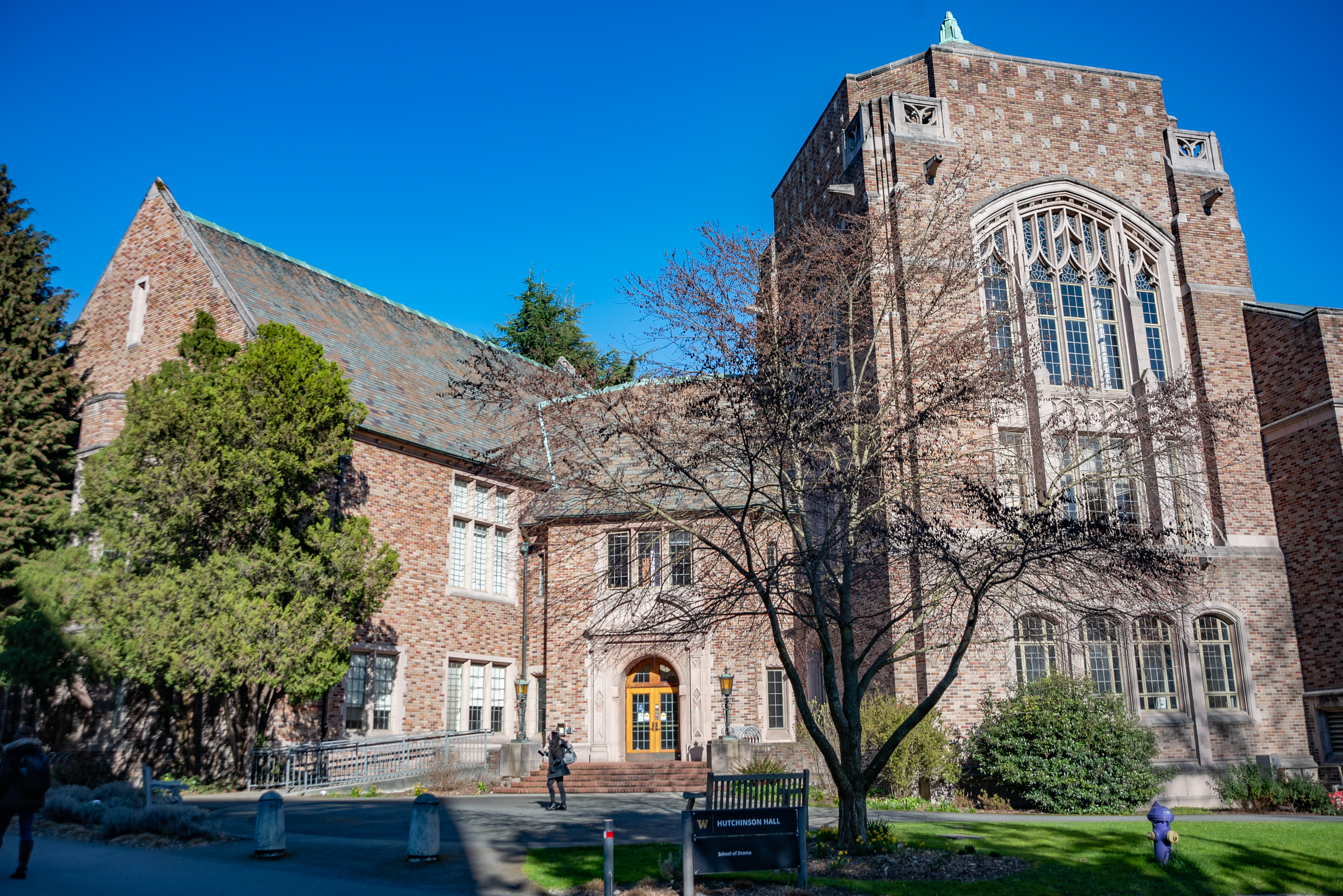
Typically presented in the Penthouse Theater or Hutchinson Hall.
Part of the School of Drama’s subscription season ticketed through ArtsUW.
Modest production budgets (typically totaling $2000-4000 in materials).
Assigned designers and technicians.
Smaller sized crews than Stage productions.
Engagement of professional guest artists (e.g. Designers, Intimacy Coordinators, Choreographers, Directors, etc.) is typically more limited than in Stage productions.
Scope of Support
Scenery—Primarily sourced from stock, with very limited, targeted builds and paint support.
Costumes—Primarily shopped and pulled from costume stock; limited alterations; no full costume builds.
Props—Limited staff support for stock pulls and purchasing, minimal build labor
Lighting—Repertory plot-based designs with targeted additions (typically 12–24 instruments), scheduled in consultation with the Master Electrician.
Sound—Rep plot-based designs with limited additions
Costume and scene shop support for Lab productions is intentionally targeted, with a typical build and load-in window of one to two weeks. Hang and focus schedules are correspondingly constrained and are coordinated in advance to align with staffing capacity and overlapping production timelines. In some cases, additional assistance may be available from trained students or student employees in production with advanced notice, with Production Management approval.
STUDIO PRODUCTIONS
Studio productions prioritize process and learning over technical support or scale of production, and they can often address pedagogical goals that cannot otherwise be addressed in Stage or Lab productions. When directed by MFA directing students, they are typically student-driven and self-produced, with strategic production management support provided to meet essential pedagogical needs.
Production budgets range in the hundreds rather than thousands of dollars and are typically targeted to specific needs as determined by faculty advisors, production management and student directors. There also may be additional budget for guest artists (typically actors) as required. Performing rights are also budgeted as required.
There are no shop builds or other direct labor support from the production shops.
Students and faculty working on studio level productions are able to request only essential items from costume and prop stocks. The Production Office can answer questions about the relevant processes and can facilitate / coordinate these requests. All production requests require advanced coordination: 2-weeks advanced notice is required for requests to be processed.
Rep plots are available for lighting and sound. Limited additions are possible, within inventory, and hung/installed by students with minimal guidance from staff. In some cases, minimal assistance may be available from trained students or student employees in production with advanced notice.
Directors are encouraged to seek out students or other colleagues interested in working on lights, costumes, and props.
Scope of Support
No assigned designers or technicians
Support of, and coordination with, the Production Office to ensure essential needs are addressed.
PM8302/REV9-03
Production Policy Memo No.4, established May, 1996
Subsequent Revisions: 9/00, 9/03, 4/26
Executive Committee Approval: 9/16/2003
Faculty Approval: 9/19/2003, 2008, 2026